

Jesus said, “Ask the Lord of the harvest to send forth laborers into his harvest.”
+Bishop Dee Pederson
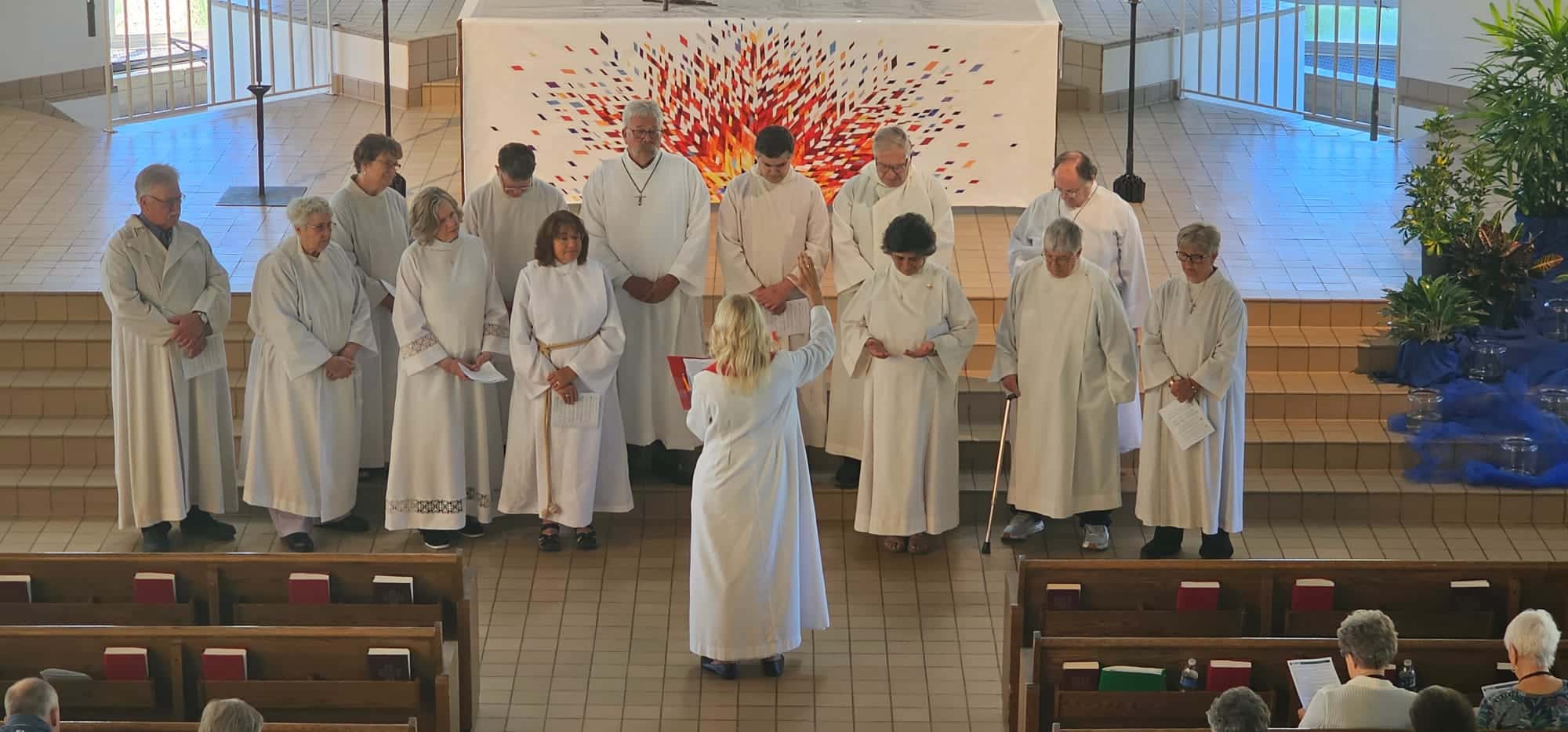
Friends, we have been praying, and the Lord has answered. On June 6, the Southwestern Minnesota Synod in Assembly commissioned Synod-Authorized Ministers at beautiful Christ Chapel at Gustavus Adolphus College, St. Peter. And God’s people rejoiced!
What is Synod-Authorized Ministry?
When a congregation does not have a settled-call pastor, they may request the synod bishop to recognize the congregation as a “synod authorized ministry site.” If there is an individual in that congregation who has received theological training, power & boundaries training, has been background-checked, and is supervised by the congregation council, the bishop may authorize an individual to serve that congregation as a “Synod Authorized Minister,” or “SAM” for short.
Why? Because congregations need to be served by word and sacrament ministry so that the gospel of Jesus might go forth, make disciples, and God’s people love and serve their neighbor. When a settled-call pastor is not available—and this is the case now and more so in the future—the congregation is in an extraordinary circumstance. My responsibility as synod bishop is to seek to raise up leaders who will provide word and sacrament ministry for these congregations and within the territory of this synod.
What training does a SAM receive?
There are numerous paths to prepare for synod-authorized ministry. Region 3 offers a two-year track of 6 courses: Bible, Lutheran theology, pastoral care, worship, preaching, stewardship, and administration. Luther Seminary offers a certificate program in lay ministry, as well as Faith-Lead cohorts.
SAMs are to be background-checked by the synod office. They must attend Power & Boundaries Training as soon as possible. They should have a contract or agreement for the responsibilities they will carry out. And they should be paid according to our synod guidelines. “The laborer deserve their wage.” - Luke 10:7
What does a “SAM” do?
That depends on the needs of the congregation and the availability and gifts of the SAM. They preach and preside worship. In addition, some provide pastoral care, teach, or serve administrative functions. What’s most important is that the congregates clear about their needs and the SAM is clear about expectations so that expectations are not missed, everyone can thrive, and the gospel go forth.
Who are our SAMs and where do they serve?
Gwen Arneson – Granite Falls Lutheran, Granite Falls
Bryan Busch – Lac Qui Parle, Dawson
Shirley Carlson – Darfur, Butterfield, Zion and St. Olaf, Odin
Andrea Dahlman – First Lutheran, Cosmos
Cami DeVries – Trinity Lutheran, Hector
Ralph Flitter – Faith, Madelia and Lake Hanska, Hanska
Bart Hill – Borgund Lutheran, Minnesota Valley Lutheran
Karen Jacobson – Saron, rural Maynard and Our Savior’s, Baxter
Karen Koder – Darfur, Butterfield, Zion and St. Olaf, Odin
Jeff Larson – First Lutheran, Marshall
Nancy Carlson – ACTS Parish
Rosine Hermodson-Olsen – Darfur, Butterfield, Zion and St. Olaf, Odin
Robert Olson – Bethany-Elim, Ivanhoe
Dale Schley – Grace, Ruthton
Linda Summerlet – Trinity Lutheran, West Lake Johanna, Brooten
Time Velde – Yellow Medicine Lutheran
Jennifer Warnock – Hope Lutheran and St. Paul Lutheran, Minneota
Don Swenson – Indherred Lutheran, Starbuck
Abby Weick – Our Savior's, Chokio
What do we call a Synod-Authorized Minister?
Great question! It would seem rather awkward to refer to someone as, “SAM Susan.” A SAM is not ordained, so they you would not address them a pastor or deacon. “Minister” is most appropriate, so, “Minister Susan.”
The appropriate attire for a SAM leading worship is an alb or business casual clothing, SAMs do not wear clerical collars or stoles.
How are SAMs supported?
Thanks to a very generous CaSTLE grant from Wartburg Seminary, we have been developing a mentor program that provides a mentor pastor to meet with the SAM and walk with them as they are developing in ministry this year. The CaSTLE grant has provided support for retreats
This seems like a future path of leadership for congregations.
Sometimes it is the past that provides signposts to the future. The congregations of this synod were organized by lay people in the mid-late 19th century and early 20th century. It was the lay people who gathered their neighbors together, read scripture, sang hymns, prayed, read sermons from books, and enjoyed Christian community. It was only later that ordained pastors began to be trained and sent to lead worship at various congregations. And it was still later into the 20th century that most congregations were led by ordained pastors.
Times have changed, demographics have led to the retirement of many pastors. Fewer students are heading to college and then seminary. And the Holy Spirit continues to do something new among us! Adults who are or have worked in various daily vocations are beginning training in theology and pastoral ministry. They continue to serve as active members of their congregations, know their community, and are trusted by their people. And they bring with them gifts from their life experience and work in areas such as teaching, social work, farming, and business. The paths to ministry have changed, but the Holy Spirit is revealing to us a way into the future.
How can this ministry grow?
On Wednesday evening, I had the honor of attending the Annual Conference of The United Methodist Church, held in St. Cloud, at the invitation of UMC Bishop Lanette Plambeck. On behalf of our synod and the ELCA, I brought ecumenical greetings and then participated in the ordination of two women, including prayers and the laying-on-of-hands. It was a humbling and moving experience to join in for these ordinations and to see the love, prayer, and care of hundreds from the area. The service also included recognizing the licensing of local pastors and those who completed courses of study.
After those times of prayer, there was an invitation for people who might sense the nudging of the Spirit to consider ministry preparation to come forward for prayer. It was moving and inspirating to join the assembly and sing, Will You Come and Follow Me and The Servant Song. A number of individuals came forward for prayer, and the assembly was inspired and encouraged at how the Spirit has been working among them.
Jesus said, “Ask the Lord of the harvest to send forth laborers into his harvest.” Friends, this is my ask of you: Pray. In your public worship services each week, ask God to send forth people who might hear the Spirit’s call to ministry. Encourage those you know who might have the faith, gifts, and temperament for ministry, to prayerfully consider ministry training. In your weekly Intercessions, “Ask the Lord of the harvest to send forth laborers into his harvest.”
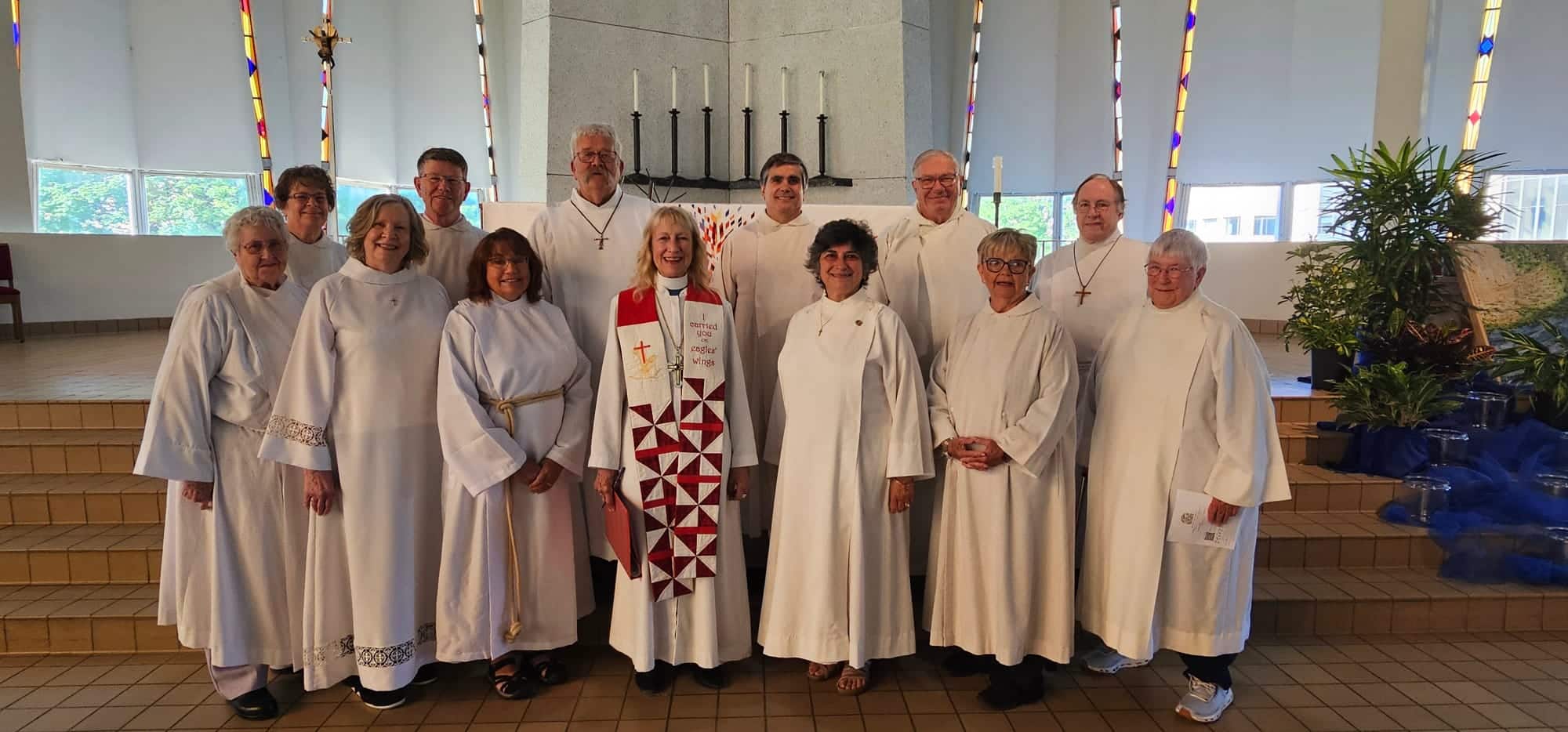
Front row, L to R: Shirley Carlson, Gwen Arneson, Karen Jacobson, Rosine Hermodson-Olsen, Linda Summerlet, Karen Koeder
Back row, L to R: Andrea Dahlman, Bart Hill, Tim Velde, Jeff Larsen, Ralph Flitter, Dale Schley
Leading worship and preaching is a significant responsibility and honor. As ELCA Lutherans, we bring a very specific theological perspective to our preaching that values God’s word and focuses on grace and the welcome of all people. If you are curious about Lay Ministry or hearing God's call, please reach out to Bishop Dee Pederson or Pastor Heather Culuris at the synod office. We would love to hear how God is calling you and help you along your vocation journey!
Bishop Dee Pederson
(507) 627-9048
[email protected]
Rev. Heather Culuris, Synod Minister
(507) 637-3904
[email protected]
Southwestern Minnesota Synod, ELCA
PO Box 499
Redwood Falls, MN 56283